


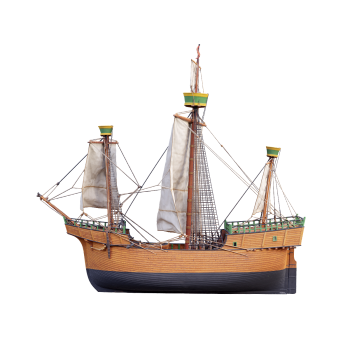
Kalak sailing ship
They were large ships used for trade, war and exploration in the 15th and early 16th centuries. Originating in the Mediterranean, it is a product of the development of sailing technology. It is known for its stability on rough seas, and has plenty of space to load cargo and supplies, suitable for long-distance sailing. Known as a "holk" in northern Europe, and were built of clinker, meaning they used an overlapping wood board structure, which was considered strong and durable at the time. The design includes a tall forecastle and stern, and multiple masts, usually equipped with square sails and Latin sails, allowing it to adapt to different wind directions.
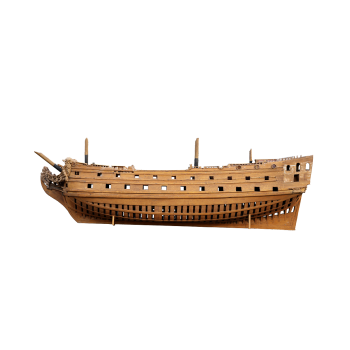
Western powers naval battleships
They were the main ships of the navies of Western powers from the mid-17th century to the mid-19th century, and they formed the core force of maritime combat at that time. Originating from large sailing ships, this three-or four-masted ship has a towering structure at the rear, usually carrying heavy artillery, and is distributed on two decks. It usually has three decks, equipped with bottom deck guns of 30 to 48 pounder shells, middle deck guns of about 24 pounder shells, and upper deck guns of 30 or more 12 pounder guns. As a symbol of sea power at that time, it was not until the emergence of steam-powered battleships that they gradually withdrew from the stage of history.

3D model of an empty cargo ship
The ships that transport goods are called cargo ships. Ships mainly refer to modern ships powered by mechanical wheels, which enable people to trade between different regions of the world. Today, a large number of different types of cargo ships built by various countries are sailing on the sea surface, ranging from large oil tankers to small tugboats, from loaded ferries to specially designed ships for searching for damaged vessels. Cargo ships rarely have upper structures (the part above the main deck). There is a navigation bridge with a chimney on board. There are engines and living quarters under the bridge. The rest of the ship can accommodate as much cargo as possible.

3D model of cargo ship
The ships that transport goods are called cargo ships. Ships mainly refer to modern ships powered by mechanical wheels, which enable people to trade between different regions of the world. Today, a large number of different types of cargo ships built by various countries are sailing on the sea surface, ranging from large oil tankers to small tugboats, from loaded ferries to specially designed ships for searching for damaged vessels. Cargo ships rarely have upper structures (the part above the main deck). There is a navigation bridge with a chimney on board. There are engines and living quarters under the bridge. The rest of the ship can accommodate as much cargo as possible.

Liquefied natural gas transport ship
Liquefied natural gas ship (LNG ship or LNG transport ship) refers to a "vessel" specialized in transporting liquefied natural gas. It is a "sea super refrigerated vehicle" that carries LNG at minus 163 degrees Celsius. It is one of the most difficult ship types to build in the world and one of the three "pearls in the crown" of the shipbuilding industry. The earliest LNG ship was the 5100 square meter "Methane Light Duo" converted from an ordinary old oil tanker in the United States in 1958. According to the structural form of the cargo tank, it can be divided into independent tank type and membrane type. Newly built liquefied natural gas ships, especially large ones, often adopt membrane structures. The equipment of liquefied natural gas ships is complex.

Large cargo ships
The ships that transport goods are called cargo ships. Ships mainly refer to modern ships powered by mechanical wheels, which enable people to trade between different regions of the world. Today, a large number of different types of cargo ships built by various countries are sailing on the sea surface, ranging from large oil tankers to small tugboats, from loaded ferries to specially designed ships for searching for damaged vessels. Cargo ships rarely have upper structures (the part above the main deck).

Offshore platform apron supply ships

Popular Models

Random Model


Portable compressor blend source file
1028 View

Weapon in Final Fantasy XV: Engine Sword
2068 View

Sansa Clip MP3 Player
877 View

Desktop grinding machine
1058 View

Apple iPhone 12 Mini Red
1421 View

Army Ant 3D Model Animation
778 View

North Pacific Snow Crab
807 View

Terminator 2 arcade game
807 View